Budget Deep Dive: Supplements
How many can we really afford in retirement?

As with many people of a certain age, we take a few supplements, both to address specific issues, or because there is evidence that a particular supplement helps support healthy aging. We are not immune to the latest health podcast trend – hello creatine and magnesium.
The supplement industry is enormous, and many of my favourite podcasts are sponsored by designer supplement companies promising that their particular cocktail, powder, gummy, or elixir is the key to youth, longevity, brain health, muscle preservation, or all of the above.
But which are the most important supplements for our particular age and health profiles, and more importantly can we afford them in retirement? Are there some blowing up the retirement budget while others are more important and affordable?

How Creatine Started an Argument About Retirement
Earlier this week my husband and I had a rather large fight about creatine. He had listened to the Diary of a CEO podcast on creatine and had quietly started taking 10 mg per day out of my container of creatine that I take irregularly to try to support muscle health.
I questioned whether we can afford creatine or not…well more accurately I stated emphatically that we could not. Okay I hadn’t had my morning coffee yet and was feeling a bit sensitive about our new deck being way over budget and being summoned for jury duty right in the middle of a long planned camping trip and course I was looking forward to.
This led to a wide ranging argument about what we can realistically afford in retirement, when we are retiring and what we want our lifestyle to look like when we do retire. To make a long story short, he envisions selling the house immediately, living in our trailer, cutting the kids off financially, and never boarding a plane again. I think he is delusional, but that is another post.
He also proposed rehoming the cat (who is a maniacal wretch that leaves too many mouse parts lying about, but a loved one).
But back to the creatine. He ardently argued that for health purposes, he should be taking it, and that it does not cost that much. And I’m taking it, albeit at a lower dose.
He is probably right. Creatine is probably at the top of the list of supplements we should be taking and it is not THAT expensive, especially once I took a closer look at the list of things we take. The fight concluded with him agreeing no more new decks and me cancelling my expensive Yoga App to make space for his creatine.
There is also the practical reality that there is a limit to how many supplements a person can take before their entire morning consists of swallowing pills, waiting for other pills, taking pills with food, taking pills without food, and wondering why their stomach hurts.
I had set our retirement budget for supplements at $100/month. That is probably a little low now that I have done the analysis, but we can hopefully get it down to $114/month. Currently we spend approximately $168/month. I included OTC pharmaceuticals in this budget, not that we take a lot—Advil and Benadryl mostly as needed, because for some reason I neglected to create a budget line item in the retirement budget for them.
The Supplement Cabinet Audit
Naturally, after a fight about creatine, I did what any reasonable person would do. I built a spreadsheet.
I took a deep dive into what we currently take, including the dosages and annual costs, what we really should take given our lifestyles, and if there are brands we can switch to.
This is our current regime (including the aforementioned creatine):
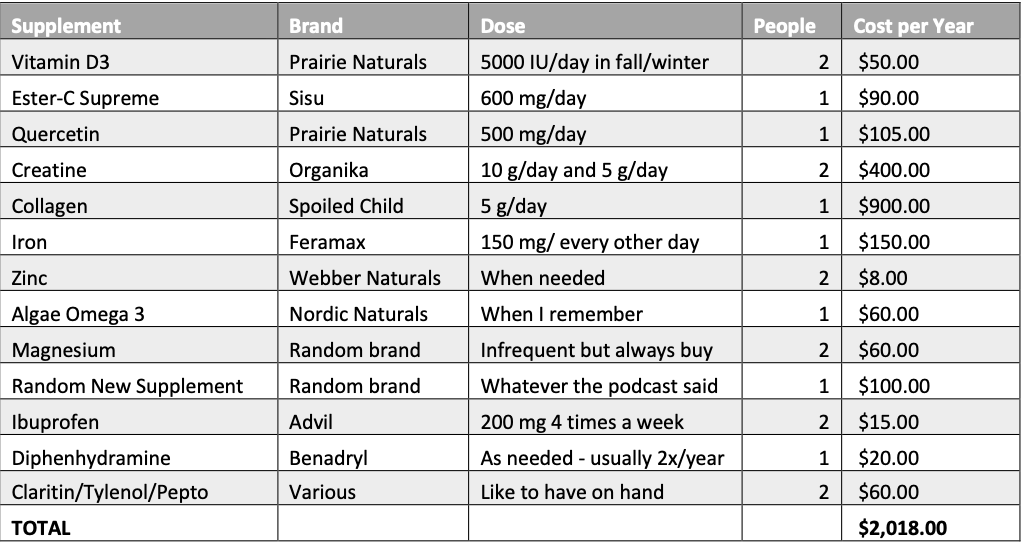
First off, I am not a doctor, or a health expert. These supplements are what work for us and what are suited to our particular needs. I have chronically low ferritin so need to take iron. Quercetin helps to control my twitchy mast cells. The others are based on a whole mix of clinical evidence, a podcast saying that they are good and just habit and “it seems to work” experience.
Some of the supplements are things we take routinely, some when we remember, and some when we need them. Some are ones that only I take, and some are ones that only my husband takes.
Expensive Pee or Healthy Aging?
I know lots of people including doctors who eschew supplements altogether, claiming that they just make your pee expensive, can become concentrated in fatty tissue and that an OTC multi-vitamin is all you need. One of my colleagues had literally never heard of taking vitamin D as a thing, while another, a former cancer researcher, took very high doses.
I honestly don’t know where the clinical evidence stands, other than just having a feeling that these are the important ones to take. The point of this post is more to consider the cost.
The Winners and Losers
A quick look at our regime and how we might adjust it for retirement and to optimize for health highlighted a few things:
1. My Spoiled Child Collagen habit is over the top. Although it is delicious and very convenient to take, there are good cheaper brands that will reduce the annual cost to $300 and I will need to switch.
2. Creatine is probably important enough to hold its place in the budget, though once I switch out the collagen it will constitute 29% of the budget.
3. Vitamin C is on probation, though I have some notion that it helps to prevent colds and flus in the winter, it is the least important vitamin in the mix. Maybe I will just take when I am feeling a bit cold and fluish like we do with Zinc.
4. I should up my dose of Omega 3. Since I am allergic to fish and seafood, it is probably a deficit in my diet and is important for brain function.
5. We should work Magnesium into our regime. Right now the budget just has us both buying a random container of it a year and failing to take it because it bugs my stomach (yes I have tried all types). We either need to commit to it or stop buying it.
6. The random supplement of the year, recommended no doubt by a podcast, needs to go.
With reduced vitamin C, a different brand of Collagen, more Omega 3, and no random supplements (I am still not giving up on the Magnesium), I can get the budget down to $114/month.
Creatine Stays. The Cat Is Undecided.
In the end, the exercise was reassuring. Supplements are not going to derail our retirement. They are less than one-tenth of our travel budget and far cheaper than decks, vehicles, or helping adult children. But like every other category, they benefit from a little scrutiny.
The creatine survives. The collagen gets demoted. The random podcast supplement has been voted off the island. I need to throw out all of the barely used magnesium bottles cluttering our cupboard
And the fate of the cat remains unresolved. But come on, really. Could you rehome this creature?